
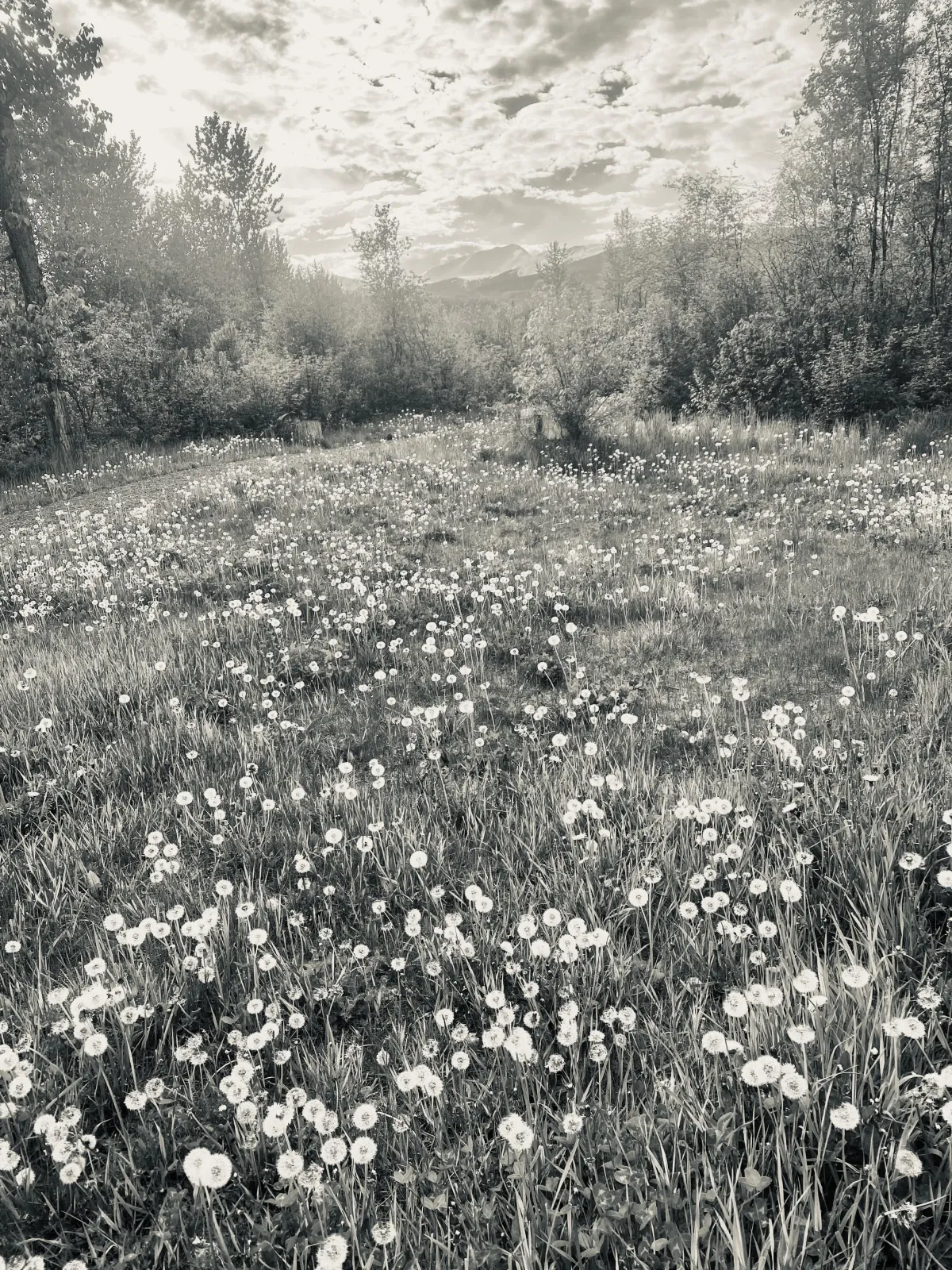
A Dandelion Led Me
A Dandelion Led Me
Funny how plants can come to define you…
In retrospect it makes so much sense how they grow into us as we grow alongside them.
In my life I have come to recognize plants, the green people, as much more than foods and medicines. To me they have become friends and allies, family members, and guides.
Oh, the things the plants have taught me!
About myself and the world…
Relationships, impacts, true intelligence! Sentience.
Lessons of the languages of shape and color, scent and sound, chemistry and energy.
But when I think about the thread that ties this all together for me,I think of the dandelion.
And I think of wishes.
Wishes floating on the breeze travelling through time.
The hopes and dreams of my ancestors' prayers. The crooked-gnarled -love soaked-olive oil-infused hands kneading memories into loaves and tossing lessons into salads.
I think of wishes floating across sunny blue skies. Wishes dancing the daydreams of childhood breathing magic into the future and back through time. The unconscious looking to find anchorage on ancestral shores so that wishes have a place to seed in far off places.
The dandelion is one of the first wild plant medicines that my grandma taught me.
We would pick them every spring to make dandelion salad.
We had to do it just so;
Find a patch of dandelion in gravelly soil where the roots were shallow and easy to dig. That's where the sweetest ones grew. You couldn’t get them from just anywhere. You had to make sure they weren’t sprayed.
We’d often pick them along the driveway towards my aunt’s farm.
We would gather the greens with particular emphasis on that little part that connects the root and the leaf together. That was the best part, according to my gram, she called it the heart.
We’d only do this maybe once or twice a year. It was a very special treat. And even though it was so bitter, we all loved it!
After you picked the plants you had to wash them. We’d soak them in very cold water in the sink, then drain them in the old metal colander, then spin them in the salad spinner.
Then we’d prepare the wooden salad bowl- the most sacred object in the kitchen. It had been seasoned for years, saturated with the stories and laughter of countless family dinners.
God help you if you ever let soapy water touch its oil anointed surface!!
We’d start with crushing garlic, then you had to rub that garlic into the bowl with your fingers. I love the metaphors of this- a layer of protection added to the sacred foundational container that holds nourishment for the family.
And only once this vital step had been completed could you add the dandelion greens. You would never, ever cut the greens with a knife, you would simply tear them with your hands.
Now the rest was very simple; a little drizzle of olive oil, a few capfuls of apple cider vinegar, then seasoning salt and finally, some fresh ground black pepper.
And then, once all the ingredients were in the bowl, the next most important thing: mix it only with your bare hands and put your love into it.
I cherish this memory of my grandma. As a child, I didn’t think of it as anything extraordinary.
But now, I wonder… who planted that knowledge in me?
Because years later, after I had begun listening more deeply to the plants, something shifted.
One day in my garden, I was transplanting a valerian plant I’d neglected too long in its pot. I rushed to get it into the ground, covered its roots—and suddenly stopped.
“I’m so sorry,” I said. “I didn’t even ask if you wanted to be here.”
And I felt, clear as anything, a response:
“Oh… you think this was your idea?”
That moment changed how I understand plant intelligence—how plants move, communicate, and participate in the world.
The dandelions were a long standing food source for my ancestors over in Italy. They were also already here to greet my family when they stepped onto the shores of a distant continent. But they weren’t always here…
They were brought to North American shores by Europeans because they were so highly valued for food and medicine..
That sunny dandelion sank deep roots into this land. Its seed, so perfectly designed to soar, flew across the continent so quickly that indigenous peoples were using them before settlers even arrived in some places.
They spread,not invasively, just opportunistic-adaptables. .
The scientific name, Taraxacum, is often translated as “bitter herb.” But from Greek roots, it can also mean “remedy for disorder.”
And that feels right.
Because wherever the soil is disturbed,. by storms, by fire, by people. Especially people, the dandelion arrives
Its taproot reaches deep—drawing nutrients up from far below, aerating the soil, nourishing the ecosystem. It feeds animals, supports pollinators, and offers one of the earliest sources of nectar for bees—who are responsible for pollinating a huge portion of our food.
Every part of the plant is useful.
The leaves, flowers, and roots are all edible and medicinal. They’re rich in vitamins and minerals. Their bitterness supports digestion. The roots can be roasted as a coffee substitute and are widely used to support liver health.
But beyond all that, there’s something else.
This cheerful plant opens its blossoms to the sun and closes them when it fades. It helps people digest experiences and process anger so we can see with clarity and radiate joy.
I’ve rarely met a child that doesn’t intuitively know this as they pick a handful of blossoms to proudly present to a grumpy parent.
So how did we come to hate them so?
How did we go from carrying them across oceans to poisoning them in our lawns?
Well, actually, lawns have a lot to do with it.
They began as symbols of wealth in Europe—land owners with such abundant properties they didn’t need it all to grow food. That idea spread to North America after World War II, alongside suburban expansion, grocery stores, and the rise of the lawn mower.
Soon, lawns became a symbol of order, control, and good citizenship.
Gardens were for the poor. Grocery stores were far more convenient.
And dandelions—resilient, wild, and abundant—became the enemy.
Let’s think about that for a minute.
We eradicated diverse, nourishing ecosystems and replaced them with controlled, non-native grass. We forced the land—and ourselves—into uniformity.
And anything that resisted—especially something as persistent and nonconforming as the dandelion—was labeled a problem.
Wow!
It was my grandma that taught me about the dandelion. It was my indigenous teachers and friends that taught me we are all related. We are all family.
I never could have known how profoundly this medicine plant would help me on my path of reconciliation.
As settlers, many of us have forgotten the strength and depth of our roots and lost sight of our own medicines; our capacity to nourish ourselves and others.
No wonder we have fallen into the trap of the never satiated colonial machine called capitalism!
Thank goodness those roots go so deep and are so hard to eradicate!
If we think of the common dandelion as a metaphor for our settler selves then they have a lot to teach us about how to be in right-relationship to this land and share the medicine we hold.
We just have to let our roots grow deep, back into the depths of ancestral memory and ancient wisdom to find our way. We just have to learn from the dandelion.
They can help lead us into right-relationship with the land and maybe even the first people of this land. They can remind us of the strength of our roots, the generosity of our people, and the wishes of all of our ancestors carried far and wide by the winds of change.


